


The choice between a mobile whiteboard and a wall-mounted one seems like a minor logistics decision. It isn't. It determines whether a room can be reconfigured on demand or stays fixed in one layout, whether floor space gets used efficiently or eaten up by a stand, and whether the board serves one team permanently or moves to wherever it's needed that day.
Both formats deliver identical writing performance - the decision comes down entirely to how the space and the team actually use it. This guide breaks down exactly when each format wins, so the choice is based on usage pattern rather than habit or guesswork.
What Actually Separates the Two Formats
Wall-mounted whiteboards are fixed permanently to a wall using brackets or direct mounting hardware. They don't move once installed - the board becomes a permanent fixture of that specific room.
Mobile whiteboards are mounted on a wheeled frame or stand, allowing the board to be rolled between rooms, repositioned within a room, or stored away when not in use. Most mobile boards use the same writing surface materials as wall-mounted versions - the difference is entirely in the support structure, not the board itself.
Neither format offers a writing or durability advantage over the other. The choice is a spatial and operational one, not a quality one.

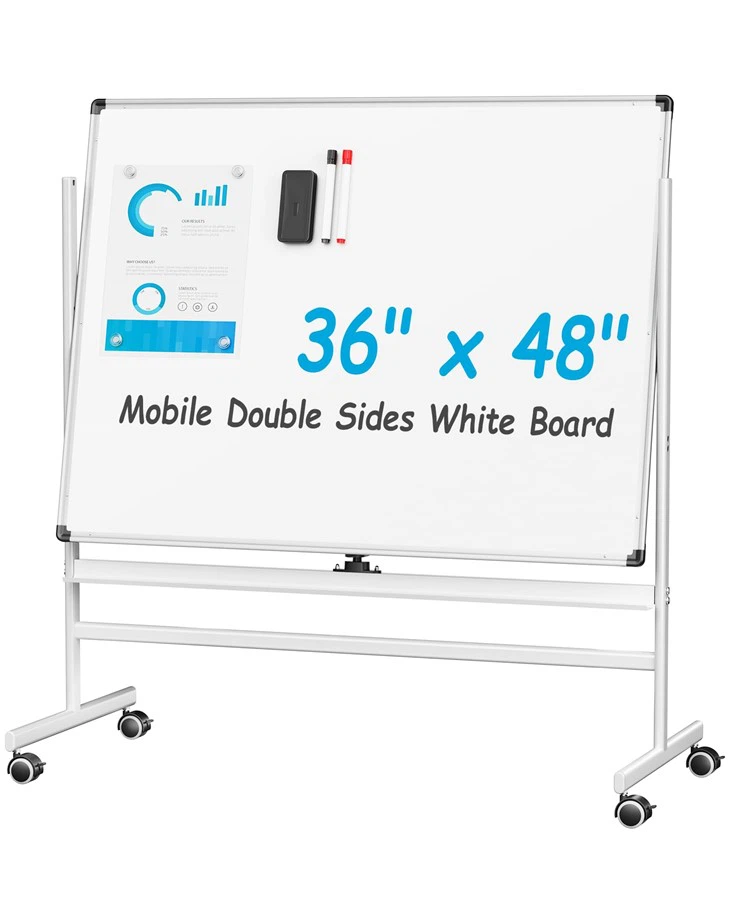
When Mobile Whiteboards Are the Right Choice
- Rooms used for multiple purposes:A training room that hosts workshops one day and client meetings the next benefits from a board that can be rolled out when needed and moved aside otherwise - keeping the room adaptable rather than committed to one layout.
- Shared boards across several rooms:Rather than installing a fixed board in every small meeting room, one or two mobile boards can rotate between spaces as needed - a practical way to reduce total unit count without reducing access.
- Frequently reconfigured office layouts:Open-plan offices and co-working spaces that regularly rearrange desks and zones need boards that move with the layout, not boards fixed to a wall that becomes inconvenient after the next reconfiguration.
- Double-sided use:Many mobile whiteboards write on both sides, effectively doubling the writing surface without doubling the footprint - useful for teams that need more surface area but not more floor space dedicated to a single fixed installation.
When Wall-Mounted Whiteboards Are the Right Choice
- Dedicated, permanent meeting rooms:A conference room that always serves the same function doesn't need the flexibility mobile boards offer - a fixed board delivers the same performance without the extra cost of a wheeled frame.
- Space-constrained rooms:Mobile stands occupy floor space even when not actively repositioned. In small meeting rooms or compact offices, that floor footprint matters - wall mounting keeps the space clear.
- Classrooms and training centers:Fixed installation at the front of a classroom ensures consistent positioning and viewing angle for every session, without the board being accidentally moved or misaligned between uses.
- Large-format installations:Very large boards - full-wall conference room panels or classroom teaching walls - are impractical on wheeled frames due to weight and stability. Wall mounting is the only realistic option at this scale.
- Lower cost per unit for large-volume procurement:Without the wheeled frame and stand hardware, wall-mounted boards are typically less expensive per unit - a meaningful factor when outfitting many rooms at once.
Side-by-Side Comparison
| Factor | Mobile Whiteboard | Wall-Mounted Whiteboard |
| Writing/erasing performance | Identical | Identical |
| Floor space used | Yes (stand footprint) | No |
| Repositioning | Easy - rolls between rooms | Fixed, permanent |
| Double-sided writing option | Common | Rare |
| Typical cost per unit | Higher (includes frame/casters) | Lower |
| Best for | Flexible, multi-use, shared spaces | Fixed, dedicated, space-constrained rooms |
| Large-format sizes | Limited by stability/weight | No practical size limit |
| Installation effort | None (ready to roll) | Requires wall fixing |
The Question That Actually Decides It
Before choosing, ask: Does this room's layout or purpose change often enough that a fixed board would become an obstacle?
If yes - the room hosts different activities, gets reconfigured regularly, or the board needs to serve multiple spaces - mobile is the right call. If no - the room has one consistent purpose and a stable layout - wall-mounted delivers the same performance at a lower cost and with zero floor space impact.
For organizations outfitting multiple rooms, this question is worth applying room by room rather than standardizing on one format across an entire order. A typical efficient mix: wall-mounted boards for permanent meeting rooms and classrooms, mobile boards for training centers, open-plan zones, and shared-use spaces.
Need flexibility? → [Browse mobile whiteboard series] Have a fixed space? → [Browse wall-mounted whiteboard series]
A Note for Bulk Buyers and Distributors
For distributors serving office fit-out projects, the mobile-to-wall-mounted ratio in a typical order depends heavily on end-use: corporate office fit-outs skew toward wall-mounted for standard meeting rooms with a smaller allocation of mobile units for shared or training spaces. Educational institutions often request a higher proportion of mobile boards to support flexible classroom and workshop configurations.
Stocking both formats - rather than defaulting to one - allows distributors to match proposals to the actual room mix in a customer's facility, which shortens the sales cycle and reduces post-delivery exchange requests.
Frequently Asked Questions
- Can a wall-mounted whiteboard be converted to mobile later?
Generally no. Mobile boards use a dedicated frame and caster base built for the board's specific size and weight. Converting a wall-mounted board would require a separate compatible stand, which is not a standard product configuration.
- Are mobile whiteboards less stable than wall-mounted ones?
Quality mobile whiteboards with a properly weighted base and locking casters are stable for normal use. However, for very large sizes or high-traffic environments where the board gets bumped frequently, wall mounting offers more consistent stability.
- Do mobile whiteboards cost more than wall-mounted ones of the same size?
Typically yes. The wheeled frame and stand hardware add manufacturing cost that a wall-mounted board's simpler bracket system doesn't require.
- Can mobile whiteboards be used outdoors or in hallways?
Some mobile whiteboards are used in covered outdoor areas or corridors for temporary signage or wayfinding, but they are not designed for prolonged outdoor exposure. Check frame material and surface coating specifications for these use cases.
- What's the best format for a room that hosts both meetings and training sessions?
Mobile is generally the better fit - it allows the board to be positioned for a meeting one day and repositioned or supplemented for a training layout the next, without being fixed to a single configuration.
Explore Wideny's Whiteboard Range
Wideny manufactures both mobile and wall-mounted whiteboards across melamine, glass, and combination formats - in standard sizes and custom specifications for bulk and OEM orders. Our team can help you determine the right mix for your project or market.
[Browse Whiteboard Product Range] | [Request a Sample] | [Get a Bulk Quote]
Wideny - Office Storage & Whiteboard Solutions for Global B2B Partners www.wideny.com
Related Articles:
[Magnetic vs. Non-Magnetic Whiteboards: Do You Really Need Magnetic? →]
[How to Choose a Whiteboard Supplier for Bulk Orders: 7 Key Factors →]


